

In your quest to build stronger, more defined arms, focusing on the best tricep exercises is essential. After all, your triceps make up most of your upper arm mass, helping you push, press, and extend your arms through countless daily tasks. Whether you are new to working out or a seasoned lifter, dialing in your tricep training will pay off in both arm definition and overall functional strength.
Below, you will find what makes tricep training so important, practical tips on structuring your workouts, a breakdown of the 10 best tricep exercises, and pointers on how to fine-tune your form for maximum results. Throughout, you will see research-backed insights from leading fitness experts at Planet Fitness, Muscle & Strength, Gymshark, and more. Let’s get started.
Recognize the importance of tricep training
Your triceps are not just secondary muscles that take a back seat to your biceps. They are a large group composed of three distinct heads (long, medial, and lateral). Together, these heads converge at the elbow and function primarily to extend your arm at the elbow joint. This extension is crucial for pushing movements, stabilizing your shoulders, and generating power in compound exercises like the bench press or overhead press.
Understanding your tricep anatomy
- Long head: Runs along the back of your arm, attaching above the shoulder joint. It is often emphasized with overhead exercises, such as dumbbell overhead extensions.
- Lateral head: Sits on the outer side of your arm. It is typically the most visible head from the side and responds well to pushdowns and diamond push-ups.
- Medial head: Lies beneath the other two heads, near your elbow. It is often recruited during close-grip presses or dips.
When you train all three heads effectively, you create balanced upper-arm development and robust pushing strength. Studies show that the triceps account for roughly two-thirds of your total arm size [1], so developing them can give your arms that sculpted and proportionate look.
Why you should train them
- Improved pressing strength: Stronger triceps boost your performance in bench presses, push-ups, and shoulder presses.
- Better aesthetics: Well-developed triceps can enhance the overall look of your arms, adding definition and thickness.
- Everyday functionality: From lifting grocery bags to pushing a heavy door open, your triceps assist in numerous daily tasks.
- Joint support: A strong tricep muscle can help stabilize your elbow joint, reducing stress and promoting healthier movement patterns.
Common mistakes to avoid
- Neglecting overhead work: Only doing pressdowns or dips can lead to underdeveloped long heads.
- Shortening the range of motion: Stopping too soon in each rep may reduce the muscle’s activation.
- Relying on momentum: Swinging or bouncing to move the weight reduces tension on your triceps and shifts the load to other muscles.
- Overtraining without rest: Your triceps need time to recover, so avoid working them heavily on consecutive days.
Set up your routine
Before you dive into the best tricep exercises, take a moment to organize your overall approach. A suitable routine addresses frequency, volume, warm-up, and equipment planning.
Frequency and volume
Research from Gymshark suggests training your triceps at least twice per week is excellent for muscle growth and strength gains, especially if you aim for a weekly volume of 12-28 sets per muscle group [2]. Consider splitting your tricep workouts between different days to allow adequate recovery. For hypertrophy, aim for sets of 8-12 repetitions at about 60-80% of your one-rep max (1RM). More advanced lifters may use higher or lower rep ranges, but this hypertrophy zone is a tried-and-true standard.
Warm-ups and stretches
A good warm-up increases blood flow to your triceps and surrounding joints, helping them handle heavier loads safely. Planet Fitness encourages dynamic arm swings, shoulder rolls, and gentle stretches [3].
- Start with 5-10 minutes of light aerobic activity or easy bodyweight moves (like push-ups from your knees).
- Gradually move into dynamic stretches. For instance, swing your arms forward and backward, rotating through full shoulder circles.
- Once warm, you can introduce slow, controlled partial reps of a lighter version of your planned exercises.
Equipment and alternatives
Depending on your access, you can train triceps using various tools or no equipment at all. If you have a gym membership, machines such as cable pushdowns and overhead cable extensions can provide constant tension. Dumbbells allow for a full range of motion and correct muscle imbalances [1]. Barbells let you go heavier, targeting overall strength. And if you prefer bodyweight-only workouts at home, dips and diamond push-ups rank among the best tricep exercises, requiring minimal or no gear.
Explore the 10 best tricep exercises
Below are 10 exercises favored by professional trainers, major fitness organizations, and strength coaches alike. Together, they can target your triceps from multiple angles, emphasizing each head of the muscle. Be sure to choose exercises that match your current fitness level, and remember to challenge yourself progressively over time.
1. Tricep dips
Tricep dips rank high on almost every list of best tricep exercises. According to Men’s Health UK, dips are considered the “king” of bodyweight tricep moves [4]. They effectively target the long head while also recruiting the lateral and medial heads.
- Setup: Grab a stable surface like a bench, chair, or parallel bars. Sit down with your hands at the edge, fingers forward.
- Action: Straighten your legs, keep your shoulders down, and slowly lower your body by bending your elbows until you feel your triceps fully engaged. Push back up, taking care not to lock out your elbows.
- Tips: If you are new to dips, start with bent knees or reduced depth, and gradually build strength. To make them harder, elevate your feet on another bench or table.
2. Diamond push-ups
Diamond push-ups, sometimes called triangle push-ups, place your hands directly under your chest so that your index fingers and thumbs form a diamond shape. This narrow grip emphasizes the lateral head more than standard push-ups.
- Setup: Assume a push-up position with your hands in a diamond formation. Feet can be hip-width or closer, depending on comfort.
- Action: Engage your core, lower your chest toward your hands, and push back up.
- Tips: If full diamond push-ups are too challenging, try knees-on-floor or inclined positioning, as suggested by Pullup & Dip [5].
3. Close-grip bench press
Barbell close-grip bench presses rank among the top compound exercises for building tricep mass [6]. By narrowing your hand placement on the bar, you shift the load from your chest to your triceps.
- Setup: Lie on a flat bench with your hands closer than shoulder-width on a barbell.
- Action: Lower the bar slowly to your mid-chest, keeping your elbows in, then press upward.
- Tips: Keep your wrists straight, and avoid flaring your elbows. Some people prefer a grip slightly wider than a strict “shoulder-width minus” to reduce wrist strain.
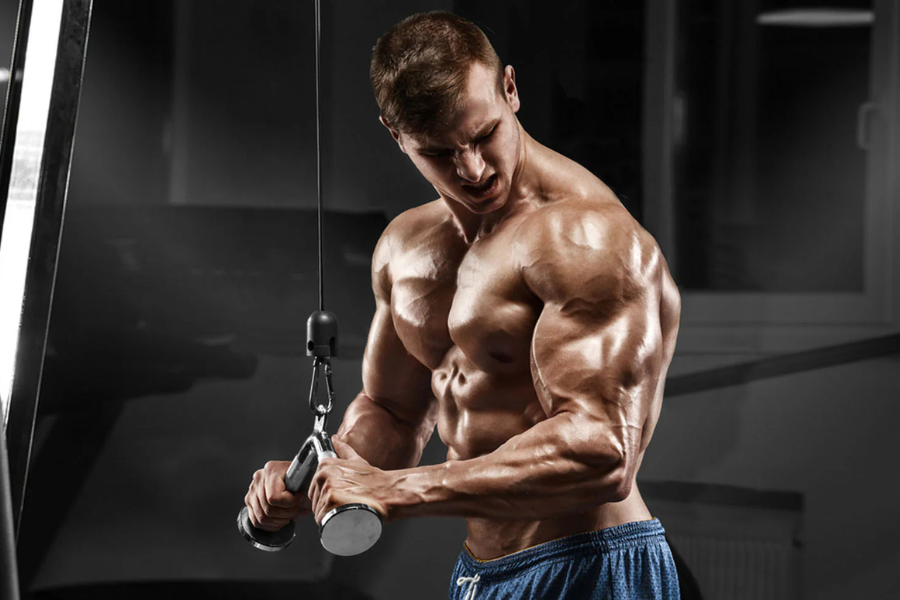
4. Tricep pushdowns
Tricep pushdowns are a mainstay at most gyms. You can use a straight bar, V-bar, or rope attachment. Rope attachments are often recommended by Gymshark and others because you can “flick” your wrists at the bottom, enhancing the contraction on the lateral and medial heads [2].
- Setup: Stand facing the cable, holding the bar or rope at chest height. Keep elbows pinned to your sides.
- Action: Push down until your elbows are nearly locked, but do not hyperextend. Return to the start under control.
- Tips: Focus on keeping your upper arms locked in place so that your triceps do all the work.
5. Overhead tricep extensions
Overhead extensions shine when it comes to targeting the long head, often the biggest part of your triceps. You can perform them standing or seated, with a dumbbell, EZ bar, or cable.
- Setup: Hold a single dumbbell (or rope attachment) overhead, elbow bent so that the weight is behind your head.
- Action: Keep your elbows close to your ears. Extend your arms upward until your elbows are straight, then return under control.
- Tips: If one heavy dumbbell feels unwieldy, try single-arm overhead extensions to isolate each side, as recommended by REP Fitness [7].
6. Skull crushers
Sometimes called lying tricep extensions or EZ bar skull crushers, this move is a classic for bulking up the back of your arms. Muscle & Strength credits skull crushers as among the best for hitting all heads of the triceps [6].
- Setup: Lie on a flat bench, holding an EZ bar or dumbbells straight above your chest.
- Action: Bend at the elbows to lower the weight toward your forehead (hence the name), then extend back up.
- Tips: Keep your elbows in a fixed position and resist the urge to let them flare. Control is key to protect your elbows and skull.
7. Dumbbell kickbacks
Dumbbell kickbacks generally target the lateral head but also engage the medial and long heads for overall definition. They allow a strong mind-muscle connection because of the stricter range of motion.
- Setup: Bend at the hips with your back flat. Hold a dumbbell in one hand, upper arm parallel to your torso, elbow bent at 90 degrees.
- Action: Drive your forearm backward until your arm is nearly straight, then slowly bring it forward.
- Tips: Keep your elbow steady by your side so that only your forearm moves. If stability is a challenge, rest your non-working hand on a bench for support.
8. Single-arm overhead tricep extension
This variation gives you the chance to work each tricep independently. It also helps correct strength imbalances.
- Setup: Stand or sit tall, holding a dumbbell in one hand. Press the dumbbell overhead, then bend your elbow until the weight is behind your head.
- Action: Extend your arm up, feeling the full stretch and contraction in your tricep.
- Tips: Keep your wrist neutral, and maintain a slow, controlled tempo. REP Fitness names unilateral movements like this as excellent for fixing muscle imbalances [7].
9. Cable overhead tricep extension
The cable version of an overhead extension keeps consistent tension on your triceps throughout the entire range of motion. Unlike free weights, cables do not rely on gravity for tension, so you can shift angles slightly to hit different tricep heads more intensely.
- Setup: Position a cable pulley at the bottom of a column. Attach a rope or bar. Face away from the machine, grasp the handle, and bring it over your head.
- Action: Extend your elbows forward, pulling the attachment upward until your arms are nearly locked out, then return to the start slowly.
- Tips: Avoid arching your back. Keep your core tight to maintain balance and protect your spine.
10. Weighted tricep dips
Weighted tricep dips bring the classic dip to a more advanced level. You can use a dip belt, weighted vest, or even place a dumbbell between your ankles. This is a direct method for progressive overload if you have mastered bodyweight dips.
- Setup: Secure your chosen weight. Grasp parallel bars, keep your torso upright, and lower yourself until your elbows form about a 90-degree angle.
- Action: Press back up, focusing on contracting your triceps.
- Tips: Men’s Health UK emphasizes keeping your elbows tucked to emphasize the triceps rather than the chest [4].
Fine-tune your form and technique
Success with these best tricep exercises hinges on proper form, controlled movements, and strategic progressions. Even minor adjustments to your elbow angle or grip can significantly influence which tricep head gets emphasized.
Range of motion
Strive for a full range of motion to activate more muscle fibers. For overhead movements, ensure you feel a stretch in your triceps at the bottom of the motion. For dips, go deep enough to engage your arms, but not so low that your shoulders cave in. Men’s Health UK warns against dipping too low to avoid shoulder strain [4].
Breathing and posture
Try exhaling on the exertion part of each rep and inhaling on the return. Keep your shoulders relaxed, chest lifted, and core braced to maintain a stable spine. Avoid letting your back arch excessively during overhead extensions, as this can shift workload away from your triceps and potentially strain your lower back.
Progressive overload
Once you master the exercise with good form, add small increments of weight or intensity. For bodyweight exercises like diamond push-ups or dips, you can raise your feet, wear a weighted vest, or add a pause at the bottom. Dumbbell lifts can be progressed by increasing weight in 2-5 pound increments or adjusting your rep range and rest intervals.
Frequently asked questions
Can you train triceps without equipment?
Yes. Bodyweight tricep exercises such as diamond push-ups and tricep dips are highly effective for beginners and advanced athletes alike [8]. You can do them using a chair, bench, or stair and vary the angle to match your ability. When you are ready, you can incorporate dumbbells, cables, or machines to further challenge your muscles.
How often should you work triceps?
Most guidelines suggest 2-3 times per week, with 3-4 exercises per session, doing 3-4 sets of 8-12 reps [9]. Adjust this based on your experience, overall program, and recovery capacity. If you still feel sore, give yourself more time to rest.
Should you lock out at the top?
Locking out your elbows can momentarily shift tension off the triceps, though some advanced lifters find it useful to emphasize a strong contraction. However, repeatedly slamming into a full lockout can strain your elbow joints over time, especially if you are lifting heavy. A balanced approach is to nearly straighten your elbow while keeping some tension on the muscle.
Recap and next steps
Your triceps are central to a range of everyday and athletic movements. By choosing a balanced mix of the 10 best tricep exercises—like tricep dips, close-grip bench presses, and overhead extensions—you can effectively hit every head of this essential arm muscle. Focus on form and gradually introduce progressive overload to spark steady gains.
Here is a quick summary:
- Prioritize the long head with overhead moves like single-arm or double-arm overhead extensions.
- Build mass and strength with close-grip bench presses, skull crushers, and tricep pushdowns.
- Take advantage of bodyweight staples—diamond push-ups and tricep dips—to train your triceps anywhere.
- Maintain proper posture, breath control, and technique to maximize activation and reduce injury risk.
- Progress slowly by adding weight, adjusting angles, or changing tempo once you master the basics.
By applying these strategies consistently, you can transform your arm routine and achieve noticeable results in both muscle shape and pushing power. Start with one or two exercises that resonate with your experience level and equipment availability, then build from there. Over time, this targeted approach will reinforce your entire upper-body routine, allowing you to press, push, and lift with confidence. Keep at it, track your progress, and get ready to see real changes in your strength and arm definition.
References
- (Men’s Health UK)
- (Gymshark)
- (Planet Fitness)
- (Men’s Health UK)
- (Pullup & Dip)
- (Muscle & Strength)
- (REP Fitness)
- (Burnlab)
- (Burnlab and Gymshark)