

Start your shoulder transformation
Strong, well-built shoulders do more than fill out your T-shirt. They support everyday moves like carrying groceries, throwing a ball, and maintaining good posture. In fact, healthy shoulders are a foundation for countless exercises in the gym, helping you push, pull, and lift without discomfort or injury. When you focus on the best shoulder exercises, you set yourself up for balanced strength and confident movement.
If you have ever struggled with tightness or nagging aches in this area, you are not alone. According to the American Academy of Orthopaedic Surgeons, a regular conditioning program that includes stretches and strengthening drills can maintain your shoulder strength and range of motion long-term [1]. By training your shoulders with the right mix of compound and isolation lifts, you can address the front, side, and rear shoulder muscles in a single weekly routine.
Before you get started, consider warming up with dynamic moves such as arm circles, light band pull-aparts, or cat-cows to boost blood flow and reduce injury risk. Research from Muscle & Strength suggests doing two light warm-up sets before the heavier lifts to prime your shoulders for action [2]. Aim for a total of around 12 to 15 working sets per week to encourage muscle growth without going overboard. And remember to rest 90 to 120 seconds between sets for optimal recovery. With those guidelines in mind, here are 10 exercises that can help you build strong, stable shoulders.
Build strength with overhead press
When it comes to foundational shoulder exercises, the overhead press is a powerhouse. It primarily targets your anterior (front) deltoids, though it also calls on the middle delts, rear delts, traps, and triceps to stabilize the movement. You can perform it seated or standing, with dumbbells or a barbell. If you want to address muscle imbalances, dumbbells are a popular choice because you must stabilize each arm independently.
According to Gymshark, pressing weight overhead can lead to significant gains in shoulder strength and size when combined with good form and a progressive overload approach [3]. To execute this exercise, stand with your feet about hip-width apart, brace your core, and press the weight straight up from shoulder level. Lower it with control for each rep. Keep your glutes and abs tight to stabilize your lower back and ensure a smooth trajectory for the weights.
- Sets and reps: 3 to 4 sets of 6 to 8 reps for strength, or 8 to 12 for hypertrophy.
- Rest: About 90 seconds between sets.
- Pro tip: If you notice your lower back arching, check your stance, tighten your core, and consider using a belt if you are going heavy.
With an overhead press, you train your ability to push powerfully and protect your shoulder girdle from imbalances. Perfect your form, progress gradually, and watch your pressing power soar.
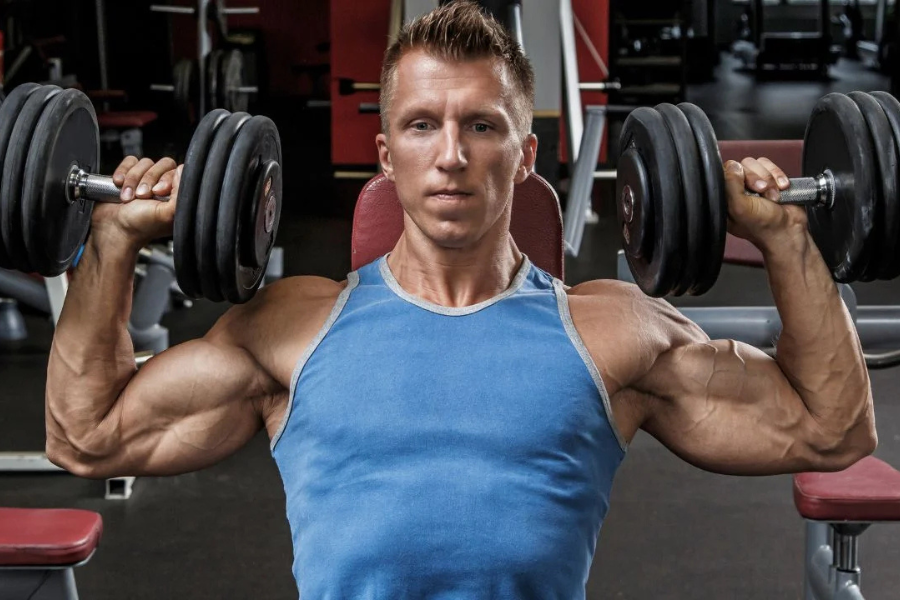
Scale up with seated dumbbell press
The seated dumbbell press differs from standing presses by taking your legs largely out of the equation. You sit upright on a bench, which reduces your ability to “cheat” with hip drive or leg push. This places more direct emphasis on your shoulder muscles. Because each side works independently, you can fix strength disparities over time.
Bodybuilding.com highlights that seated dumbbell presses are excellent for balanced development, giving each shoulder equal workload and a chance to catch up if one side lags [4]. Proper form here is critical. Sit with your back in a neutral position, feet firmly on the floor. Start with the dumbbells at ear level, palms facing forward. Press them overhead in a controlled manner, then lower them slowly.
- Sets and reps: Try 3 or 4 sets of 6 to 10 reps to focus on strength, or up to 12 reps if you want to emphasize muscle endurance.
- Rest: 60 to 90 seconds between sets helps you keep intensity high.
- Pro tip: Keep your torso upright and core engaged throughout the entire range of motion. Avoid arching your lower back.
If your gym routine has space for two pressing variations, the seated dumbbell press is an excellent complement to the standing overhead press. This one-two punch will challenge your shoulders in slightly different planes and boost total strength.
Try the landmine press
Landmine presses are a smart option if you struggle with standard overhead presses due to limited shoulder mobility or an existing shoulder tweak. Instead of pressing straight up, you guide the bar at a diagonal angle, which places less strain on the shoulder joint while still hitting the anterior and lateral delts.
Gymshark recommends this compound exercise because it also works your upper chest, triceps, and core to some degree. By adjusting your foot stance, you can shift the emphasis between your shoulders and your supporting muscles [3]. To do it, wedge one end of a barbell into a landmine attachment or corner. Face the bar’s free end, hold it near shoulder height with both hands (or one hand for a unilateral challenge), and press upward in a controlled arc.
- Sets and reps: 3 sets of 8 to 12 reps, focusing on smooth movement.
- Rest: 60 to 90 seconds.
- Pro tip: Keep your hips and torso stable. The diagonal press path should feel natural, not forced.
Whether you are returning from a minor shoulder issue or simply looking for variety, the landmine press can be a shoulder-friendly move that still builds serious strength.
Go classic with Arnold press
Invented by the legendary bodybuilder Arnold Schwarzenegger, the Arnold press slightly modifies a standard dumbbell press by rotating your wrists during the lift. You start with your palms facing you at shoulder level, then rotate them outward as you press up. This tweak can activate both the front and side delts, even touching the rear delts slightly as you rotate.
Bodybuilding.com notes that this rotation often feels more comfortable on the joints than standard presses and helps target multiple portions of the deltoid more effectively [4]. Be mindful not to overload the weight if you are a beginner. Master the rotation first, then add resistance gradually.
- Sets and reps: Consider a pyramid set, for example, 12, 10, 8, 6 reps, increasing weight as you go.
- Rest: 60 to 90 seconds between sets.
- Pro tip: Keep the rotation smooth and in sync with your pressing motion. The biggest mistake is jerking the weights or rotating too early.
The Arnold press keeps your shoulders guessing and can unleash new growth by forcing them through a wider range of motion.
Add rear delt rows
You might think rows belong exclusively in a back workout. However, the version often called the rear delt row specifically hammers the back portion of your shoulders. By pulling with your elbows out wide, you place a spotlight on your rear delts and mid-back muscles, which often do not get enough attention in pressing-dominant workouts.
A Bodybuilding.com article points out that rowing movements can sometimes activate the rear and middle delts more effectively than typical lateral raises or upright rows [4]. To perform a rear delt row, bend forward at the hips with a flat back, hold a pair of dumbbells or a barbell, and row upward so your elbows flare out to the sides. Focus on squeezing those rear delts and keeping momentum minimal.
- Sets and reps: 3 sets of 8 to 12 reps is a sweet spot for hypertrophy.
- Rest: 60 seconds between sets.
- Pro tip: If you find yourself shrugging your shoulders, lighten the load so you can target the rear delts accurately.
By including rear delt rows, you shore up potential weak links and create a fuller, more balanced shoulder profile.
Emphasize lateral raises
When you want that coveted “caps” appearance across your shoulders, lateral raises are your friend. This isolation move targets the lateral (side) deltoids, building wide shoulders and a V-taper look. Because your side delts are relatively small muscles, you do not always need a ton of weight. Slow, controlled reps go a long way.
Gymshark recommends lighter to moderate weights to help you focus on precise form [3]. A Gold’s Gym guide suggests sticking to 4 sets of around 12 reps each, which is sufficient for size and endurance [5]. Stand upright, hold dumbbells at your sides, and lift your arms out to your sides until they reach about shoulder height. Pause briefly, then return to the starting position.
- Sets and reps: 3 or 4 sets of 10 to 12 reps.
- Rest: 60 seconds between sets.
- Pro tip: Avoid swinging or using momentum. Keep your back straight and chest lifted.
Lateral raises work wonders for adding width, enhancing symmetry, and giving your shoulders that impressive shape.
Sustain posture with face pulls
Face pulls rarely get the headline treatment, but they are vital for healthy shoulders. They target your rear delts, rhomboids, and upper traps, strengthening the postural muscles that keep your shoulders back and aligned. Over time, consistently practicing face pulls helps you stand straighter and can reduce the risk of chronic shoulder aches.
Gymshark recommends performing face pulls with an underhand grip to emphasize the rear delts [3]. To do them, attach a rope handle to a cable machine at around eye level or slightly higher. Grasp both ends of the rope with your palms facing up, step back so the weight stack lifts, and drive your elbows up and back as you pull the rope toward your face.
- Sets and reps: Go for 3 sets of 12 to 15 reps.
- Rest: 60 seconds between sets.
- Pro tip: Keep your elbows high, focus on pinching your shoulder blades together, and avoid letting your wrists collapse or your elbows drop.
Strong rear delts and upper back muscles are a must for balanced shoulders. Face pulls are a simple but powerful way to create that stability.
Leverage the military press
Similar to the overhead press, the military press is done from a standing position with feet close together, demanding even more core stability and focus on form. You hold a barbell at your collarbone, palms forward, then press it overhead while keeping your torso braced. Dumbbell variations can be even more challenging because you stabilize each arm independently.
Bodybuilding.com describes military presses as a challenging full-body lift that encourages significant muscle activation [4]. While similar to a standard overhead press, the narrower stance can isolate the shoulders even more. Just be cautious about leaning back. Keep your spine neutral to avoid straining the lower back.
- Sets and reps: 3 to 5 sets of around 5 to 8 reps for strength, or 8 to 10 reps for size.
- Rest: 90 to 120 seconds if lifting heavier.
- Pro tip: Use a slight knee bend if absolutely necessary, but do not turn it into a push press. The goal is strict shoulder work.
If you want to challenge your core and build pressing power at the same time, the military press can push you toward new performance highs.
Optimize with upright rows
Upright rows have stood the test of time in many shoulder routines. This exercise involves pulling a barbell or pair of dumbbells upward along the front of your body while keeping your elbows above your wrists. The motion targets your lateral delts, upper traps, and even your forearms as you maintain a solid grip. However, you should keep an eye on form to avoid potential shoulder impingement.
According to Gymshark, you can reduce injury risk by not bringing your elbows too high and by staying within a range of motion that feels comfortable [3]. To do upright rows, stand with a moderate-weight barbell or dumbbells in front of your thighs, hands about shoulder-width apart. Pull up until your elbows are around shoulder height, then lower smoothly.
- Sets and reps: 3 sets of 8 to 12 reps.
- Rest: 60 to 90 seconds between sets.
- Pro tip: Keep your wrists straight, and lead with your elbows. Avoid jerking or shrugging aggressively.
When executed with care, upright rows can round out your shoulder workout by emphasizing the top half of the movement pattern often used in presses and pulls.
Explode with the push press
If you are looking to handle heavier loads than a strict overhead press normally allows, the push press can take your shoulders to the next level. It introduces a small “dip” and drive from your legs to power the weight overhead, engaging your whole body while still primarily targeting the shoulders. This exercise can help you blast through plateaus once you have built a foundation of strict presses.
Bodybuilding.com lists the push press as one of the top shoulder exercises, enabling lifters to train with more weight for growth and strength gains [4]. To do it, stand with the barbell at shoulder height, dip your knees slightly, then extend upward explosively. Focus on controlling the descent to avoid bouncing or losing balance.
- Sets and reps: 3 or 4 sets of 6 to 8 reps.
- Rest: 90 to 120 seconds.
- Pro tip: Keep your core braced and time your leg drive with the press. Done correctly, it feels like one seamless movement.
Speed, power, and shoulder strength all come together in the push press. It is the perfect finishing touch if you love explosive training.
Wrap up your shoulder plan
You have learned about 10 of the best shoulder exercises, spanning pressing, pulling, and isolation moves. Now it is time to piece them together. Here are a few programming tips:
- Choose 2 or 3 compound lifts. Pick from overhead press, military press, Arnold press, landmine press, or push press.
- Add 1 or 2 isolation moves. Lateral raises, rear delt rows, and face pulls work well to hit the supporting delts.
- Mind your total volume. Muscle & Strength recommends not exceeding about 15 total sets for your shoulders each week to stay safe and progress [2].
- Warm up properly. Consider light band exercises, cat-cow stretches, or scapular push-ups to get blood flowing.
- Maintain good form. Listen to your body, adjust weights as needed, and remember to keep your elbows and torso aligned appropriately for each move.
You can work your shoulders once or twice a week, depending on how quickly you recover. If you train them twice weekly, spread the exercises so you do not overwork the same muscle group on back-to-back days. And with each session, keep fine-tuning your form. Even small changes can translate into better isolation, more stable joints, and fewer injuries.
Ultimately, consistent practice and progressive overload are key. If you can lift more weight or perform more reps with solid form, you are on the right track. Emphasize compound movements for mass and stability, then round out your program with isolation work to sculpt and protect each region of the shoulder. That balance will help you stand taller, move more confidently, and enjoy the payoff every time you reach overhead without a twinge of pain. Your shoulder transformation starts now.